Showing posts with label 1906. Show all posts

Monday, April 23, 2007

Hotaling Place


If, as they say, God spanked the town for being over frisky,
Why did He burn the churches down and save Hotaling's whiskey?

In April 1906, fire —and dynamite— took down most of San Francisco from the Mission District to the northern waterfront and from the Bay to Van Ness. A total of 28,000 buildings were lost. A few pockets inside the burned district were saved due to the whimsey of wind and flame, or local heroism. Hotaling's was the savior of this particular pocket, that is now called Jackson Square.
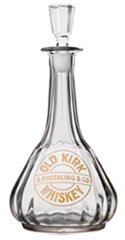
Here's the story: the Army wanted to dynamite the Jackson Street buildings,
including Hotaling’s, to create a firebreak to save the nearby U.S. Appraiser’s Building. However, as the Hotaling’s manager pointed out, a few sticks of dynamite, the woodframe building and the 5,000 barrels of Old Kirk whiskey stored inside would have created rather more firestorm than firebreak. (Some say an exchange of gifts of cash or alcohol may have facilitated the decision.)

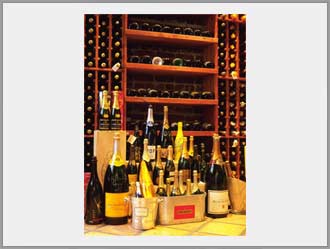
The little street named for Hotaling’s started life as Jones Alley. Close to the original waterfront, Jones Alley served the function of an alley: the service entrances to nearby businesses, a place where freight conveyances (carts and wagons), drawn by (manure-producing) horses could wait for pickups and deliveries out of the way of more proper traffic along the more major thoroughfares. For many years in the last decades of the 1800s, I. Landsberger & Co. champagne manufacturers and distributors were open for business at 10 and 12 Jones, right about where the Bubble Lounge is today.

In 1903, Jones morphed into Jessop. (Perhaps commemorating New York native Andrew Jessop, a manufacturer of spices… more research needed to get the scoop on why the name changed.)

Jessop remained Jessop through the pre-fire boom, the fire itself and the post-fire reconstruction. It remained Jessop through the mighty days of the Barbary Coast, and through the (relative) clamp-down of Prohibition. Then, along about the time that the 18th Amendment (banning the manufacture, transportation and sale of alcohol) was repealed, Jessop Alley became Hotaling St. The timing may have been a coincidence.

(In commemoration of 100 years since Hotaling's heroism, San Francisco's Anchor Brewing Company has created a new Hotaling's Whiskey.)


(Map)

Thursday, August 24, 2006

Grand - Grace

Nineteenth Century Grand Avenue. Or, more accurately, Grandiose. It’s an alley, and it only lasts one block. In fact, it’s one of two alleys (along with Washburn) that slice through the block from 9th to 10th, and Mission to Howard.

(Since the great street renaming around 1909, Grand lost some of its grandeur with a new name: Grace—which is still a touch high-falootting for such a modest alley.)

Number 35 Grand Avenue was home to the O'Brien family in 1906. 13-year old James Joseph O’Brien, his older brother Milton and their parents rented the 3-story wood-frame flat for $18 a month, sub-letting the top story to the engineer of the bath house across the street and the engineer’s wife. (The sub-renters paid the O’Briens $18/month, thus offsetting the cost nicely).

In pre-fire-quake days, Jim and his family shopped around the corner on 9th street. (Five cents for a loaf of bread, a dozen donuts for a dime. The butcher gave them free liver for the cat and knuckle bones for the soup.)

The first jolt that Wednesday morning on April 18 caused Grand Avenue’s wood-frame houses to dance a nice shake-rattle-and-roll. When the music was over (45 seconds after it started), the houses readjusted themselves and returned to their original upright, standing positions. But, while redwood sways nicely when it needs to, brick chimneys don’t. Showing little grace, the chimneys toppled, as did the contents of the kitchen- and medicine-cabinets.

But don’t worry about Jim and his family. Fire did wipe out their flat but not until many hours later—plenty of time to move their belongings south out to Potrero and Oakdale. And, the family had insurance with Liverpool, London and Globe, which paid sufficiently that the O’Briens could put up a pre-fab house with funds left over for a 14-person burial plot at Holy Cross Cemetery.

(Mr. O’Brien’s reminiscences were published in a now out-of-print volume called 1906 Remembered.)

Wednesday, August 02, 2006

Daniel Burnham

Daniel Burnham? But he’s from the Midwest. What’s he doing in San Francisco?

With a whopping 50 years of statehood under its belt, early 20th century San Francisco was the biggest port, the biggest industrial center, and in fact the biggest city on the west coast. Nearly half a million people were San Franciscans (up from around 500 in the 1840s). Former mayor James Phelan and other civic boosters wished to bask in the proper international recognition of our greatness. In 1903, they hired the world’s greatest urban planner (Daniel Burnham) to show us how to make San Francisco the Paris of the Pacific.

When it was unveiled, six months before the great quake-fire of April 06, Burnham's plan was clearly too costly to implement. Too many buildings would need to be destroyed in order to create the broad Champs Elysees-like avenues, the spiraling roads that would climb the hills, the grand amphitheatre and parks.

But then, voila, the city burned down. 28,000 buildings were destroyed. The perfect opportunity to start over from scratch, right? Wrong.

Each day needed for construction, was a day that businesses weren’t earning income. Private parties needed to rebuild ASAP. The city’s tax base was destroyed (and the credibility of its politicians was in the basement—but that’s another story for another day). With a reduced city budget, public projects were out of the question. Burnham’s plan was largely ignored.

But the plan had its merits, apparently sufficient merits for Mr. Burnham’s name to grace this little street. (Actually, San Francisco’s civic center—combining politics and the arts—was the one part of the plan that we followed. Thus, it's not incorrect the D. Burnham Ct. should be near civic center.)

(For a great bio of Burnham, check out the New York Times bestseller Devil in the White City—author Eric Larson manages to transform a rather dull topic (project management for the 1893 Chicago World’s Fair) into a fascinating page-turning read, by juxtaposing Burnham’s story with the nationalenquireresque but true story of contemporary serial killer Herman Webster Mudgett, aka H. H. Holmes.)

(Map)

Saturday, July 29, 2006

Ecker


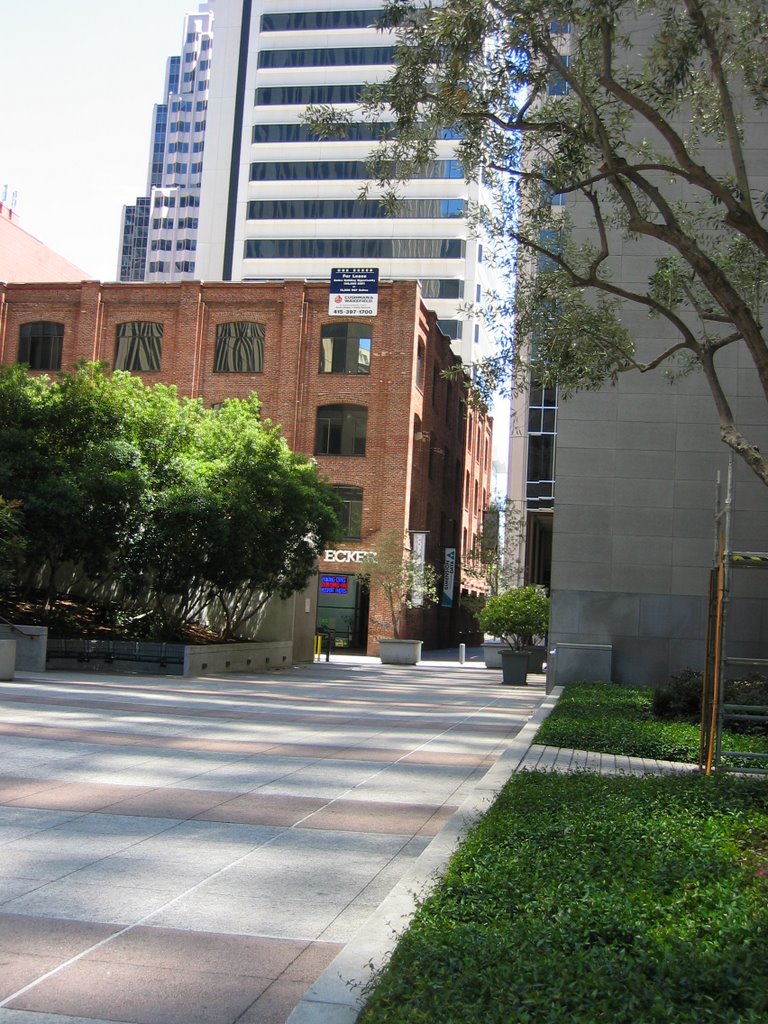
A lunch-time park sits on Market Street, right where Ecker Place began at the turn of (the previous) century. One Ecker is now a block in, at Stevenson. Ecker now--as then--continues past Jessie and Elim to Mission Street where it stops without ceremony.

The immediate-post-fire building at One Ecker is your classic unreinforced masonry building (or UMB, as they say in the trade)--rows of pretty red brick lined up side-by-side, with every 5th or 6th row being end-to-end. Its deep-set windows give another clue that it's UMB. Of course now you can see the external steel bolting that attaches floors to walls, and the internal cross-bracing -- evidence of more recent (probably post-Loma Prieta) earthquake retrofitting. As charming as it is, don't be fooled by the retrofit: in a really good jolt, the building won't collapse catostrophically, but it is likely to throw its brick facade off into the middle of Ecker and Jessie and Stevenson. (In a really good jolt, if you're inside, stay inside; if you're on the street, cozy up next to a building so that the bricks fall past you.)

Across from One Ecker is a skyrise--sit inside or out here, and emjoy Yank Sing's sweet and savory dim sum offerings. Or, walk a few steps south to the building that once housed Swallow. I haven't tracked the story of Swallow Printing, but this plaque hints at bits of nostalgia from the building that now. Just a bit further along Ecker is a lovely park (the fountain burbles weekdays, is quiet on weekends), and then you pass the eminently forgettable (if I didn't keep reminding you) Elim Street, then a cyclone-fenced empty lot.

(Map)